Showing posts with label Philippine Record. Show all posts

10.9.07

Oldest School in the Philippines

The University of San Carlos (USC) in Cebu City is considered as the oldest school in the country and in Asia. Formerly known as the Colegio de San Ildefonso, it was founded by the Spanish Jesuits on August 1, 1595. This makes the Cebu-based university older than the University of Santo Tomas (1611) in Manila and Harvard University (1636) in the United States.

The University of Santo Tomas, however, contests this title. Formerly known as the Colegio de Nuestra SeƱora del Rosario, UST was the first school, which got a university status in 1645. USC became a university in 1948. UST also claimed that the original USC was closed in 1769 as a result of the expulsion of the Jesuits. It reopened in 1783 under a new name and ownership. But the USC officials stick to their claim. The university observed its 400th foundation day on August 21, 1995.

Related article

Largest Medical Institution in the Philippines

The Philippine General Hospital in Manila is considered as the country's largest medical institution. It occupies 10 hectares of prime Manila real estate, 45 buildings, and 125,000 square meters of floor area. The hospital has over 1,000 in-patient beds and receives 3,000 outpatient visits per day. It was established on September 1, 1910.

Biggest Amphitheater in the Philippines

The Freedom Ring Giant Amphitheater in the controversial Expo Filipino in Pampanga province is considered as the largest amphitheatre in the country. It can hold as many as 35,000 people at a single event. Expo Filipino, however, has yet to become fully operational.

Largest Coliseum in the Philippines

At the time it was completed in 1959, the Araneta Coliseum in Cubao, Quezon City was touted as the world's largest covered entertainment center. Otherwise known as the Big Dome, it has a floor area of 2,300 square meters and a seating capacity of 33,000 people and is the largest coliseum in the Philippines.

Largest Oil Spill in the Philippines

On August 11, 2006, carrying a cargo of 2.4 million litres of bunker fuel in 10 sealed tanks, M/V Solar I sank about 30 kilometres southwest of Guimaras Island in the Philippines and leaked approximately 200,000 litres of oil in the five days since it sank.

Source

9.9.07

Largest and Westernmost Province in the Philippines

Palawan is considered as the largest and westernmost province in the country. It has a total land area of 14,896.3 square kilometers distributed in 1,769 islands and is composed of one city, 23 municipalities and 431 barangays. The next largest provinces in the country are Isabela, with a land area of 10,664 square kilometers; and Cagayan, 9,002 square kilometers.
The Philippine archipelago lies between 4° 40 N and 21° 10N latitude and between 116°40' and 126° 34' E longitude. Palawan lies between 08°30' and 12°45'N latitude and 117°30' to 121°45'E longitude.

Largest City in the Philippines

Davao City is the largest city in the country. Its land area covers 2,212 square kilometers. Most of these areas, however, are distributed as forests, coconut groves and rice fields. In comparison, Metro Manila covers only 636 square kilometers.

Davao City lies at the mouth of the Davao River near the head of Davao Gulf. It encompasses about 50 small ports in its commercial sphere. Davao has large banana plantations, whose produce are exported to Japan and other countries. The city also boasts of a modern international airport. Puerto Princesa City, a chartered city of Palawan province, is disputing Davao City's title. It claims to have a total land area of 2,539 square kilometers encompassing 66 barangays.

Most Populated City in the Philippines

Quezon City in northern Metro Manila is the country's most populated city. With a total population of 2.17 million as of 2000, Quezon City is composed of numerous subdivisions and has the highest concentration of urban poor residents in Metro Manila. Other highly populated cities in the country are Manila, with 1.58 million residents; Caloocan, 1.18 million and Davao, 1.15 million.

7.9.07

Highest Mountain in the Philippines

The highest mountain in the Philippines is Mt. Apo, a dormant volcano found in Mindanao, at 2,954 meters (9,689 feet). Mt. Pulog in Luzon is the second highest at 2,928 meters (9604 feet).

Source

Highest Waterfalls in the Philippines

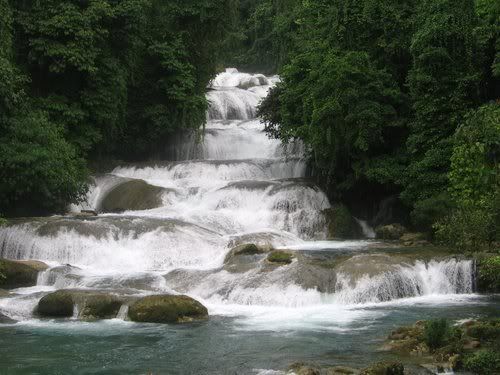
The highest waterfall in the country is the 388-meter-high Aliwagwag Falls, in Cateel town, Davao Oriental province. The cascade has 13 rapids and looks like a stairway with 84 steps of varying heights.

The second highest waterfall is located in Barangay Rogongon, 54 kilometers from Iligan City. Limunsudan Falls, a two-tiered fall, has a combined height of 870 feet. Its lower cascade alone measures 400 feet, higher than the entire height of Maria Cristiana Falls.

Maria Cristina Falls, also in Iligan City (Lanao del Norte), towers at 320 feet. Also known as the "Mother of Industry", Maria Cristina Falls supplies 80 percent of the total energy requirement of the Mindanao region. Another breathtaking waterfall in Iligan City is the Tinago Falls, located 13 kilometers from the city proper. As its name implies, this 420-foot waterfall lies hidden in a deep ravine. The world's highest waterfall is the Angel Falls in Venezuela. As a tributary of Caroni River, this waterfall has a total elevation of 3,281 feet.

Largest Native Land Animal and Endangered Land Animal in the Philippines

The Tamaraw, scientifically known as Bubalus mindorensis is the only native bovid to the Philippines, and is the countries largest native land animal. It is endemic to the island of Mindoro. Belonging to the family of buffalos, the same categorical group of the Philippine carabao, the Tamaraw is the largest endangered land animal in the Philippines today. In 1996, the International Union for the Conservation of Nature (IUCN) listed it as one of the ten most endangered species in the world.

People used to call Mindoro as the "Land of the Tamaraws". About 10,000 heads of these unique pygmy water buffalos were roaming around the island-province of Mindoro in the 1900s.

Largest Eagle in the Philippines

The endangered Philippine eagle also known as the monkey-eating eagleis one of the largest in the world. With scientific name Pithecophaga jefferyi, the Philippine eagle lives in the rainforests of Isabela, Samar, Leyte and Mindanao. It has similarities with Papua New Guinea's Harpy Eagle (Harpyopsis novaeguinea).

Smallest Hoofed Mammal in the World

South of Palawan, lies the Balabac Island, home of the world's smallest hoofed mammal - the Philippine mouse deer. Locally known as Pilandok (Tragalus nigricans), this ruminant stands only about 40 centimeters at the shoulder level.